

Los Pinetos–Newhall Nike Site (LA-94)
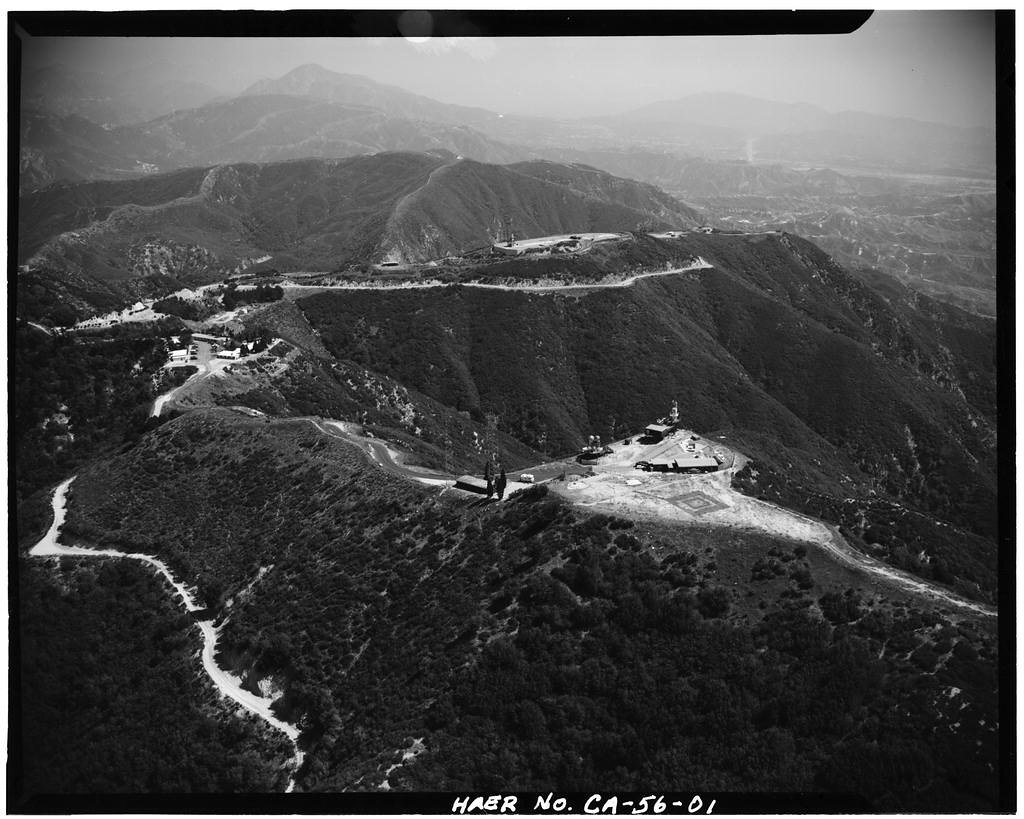
Perched 4,000 feet above the San Fernando and Santa Clarita Valleys, the Los Pinetos-Newhall Nike Site (LA-94) in the western San Gabriel Mountains, kept silent vigil over the region during an era of nuclear uncertainty. Active from 1955 to 1968, this remote outpost, along with Mount Gleason (LA-04), saw the full arc of Nike missile development, from the supersonic Ajax to the nuclear-armed Hercules. Los Pinetos-Newhall Nike Site was known for its distinctive layout, where every area fell within a single line of sight, offering a complete visual representation of a full Nike site.
 Location Map
Origins
The Nike program was born out of the aftermath of World War II, at a time when global warfare was entering a new era.
Recognizing the urgent need for a more advanced air defense system, the U.S. Army called on Bell Labs in 1945 to develop something entirely new: a guided missile system designed to intercept enemy aircraft. They named it Nike, after the Greek goddess of victory.
As the Cold War gripped the world, the fear of a Soviet attack on American cities grew more real by the day. The devastation of Hiroshima and Nagasaki was still fresh in the national memory.
Then, in 1949, the unthinkable happened: the Soviet Union tested its first atomic bomb. A countermeasure had to be found immediately…
The solution: the Nike Ajax, the nation’s first anti-aircraft missile system – built to ensure America’s survival.
 The Cold War: An uneasy peace that lasted for nearly half a century
To shield America’s most vital cities, rings of Nike missile sites sprang up around major urban centers—Los Angeles alone was encircled by 16, forming one of the most heavily fortified defense perimeters in the nation. Buried underground, the missiles sat on constant alert, ready to rise and launch at the first sign of danger.
 A ring of Nike missile sites surrounding the greater Los Angeles area
Los Pinetos was one of several Nike missile installations situated in the rugged terrain of the Angeles. The other sites were Barley Flats/Mount Disappointment (LA-09), Mount Gleason (LA-04), and Magic Mountain/Lang (LA-98). Each played a vital role in the Cold War defense of Los Angeles.
 1980 Aerial showing all three sites of the Los Pinetos Nike complex
Construction on Los Pinetos began in 1955, carried out by the U.S. Army Corps of Engineers with permission from the U.S. Forest Service. Like other standard Nike installations, the base was divided into three main sections:
- Launch Area – Equipped with underground storage magazines, this is where missiles were kept until they were raised and fired.
- Administration Area – This area served as the base’s headquarters and included barracks, offices, and support facilities for personnel.
- Integrated Fire Control (IFC) Area – This section housed the radar and computer systems used to detect and track enemy aircraft and to guide Nike missiles to their targets.
At Los Pinetos–Newhall Site, the Launch Area stood at the extreme eastern tip, stretched across a narrow 3,845-foot plateau, its missiles poised to guard the skies over Los Angeles. Midway along the ridge, the Administrative area occupied a lower shelf at 3,860 feet. The IFC area stood at the ridge’s western end on a 4,020-foot plateau, an ideal vantage point for tracking potential threats.
The structures listed below aren’t a complete record of all the facilities that once stood at Los Pinetos Nike base — but they include the significant structures documented in declassified military files and civilian records.
Launch Area
The Los Pinetos–Newhall Site is accessed via Forest Service Road 3N17, also known as Santa Clara Divide Road – a narrow, winding paved route branching off from Little Tujunga Road at Bear Divide.
At the eastern end of the Nike complex, the Launch Site is the first area reached by road. This was where Nike missiles were stored, maintained, tested, and kept ready to fire at a moment’s notice.
 Aerial View Showing Launch Area In Forefront, 1988. Credit: HAER, LOC.
Several key buildings are noted in written accounts of the Los Pinetos–Newhall Launch area: a ready room, fallout shelter, missile assembly area, warheading building, and an acid fueling station. These structures stood alongside three underground missile storage bunkers, which housed the Nike missiles until they were launched.
 Aerial image of Launch area orientation as it looks today.
- Ready Room: This was where soldiers remained on high alert in 24-hour shifts, prepared to respond instantly to any emergency launch order. Because raising the missiles from their underground magazines and preparing them for launch had to be completed in under five minutes, it was critical to have personnel stationed here at all times, ready to act at a moment’s notice.
- Fallout Shelter: Built in 1961, this reinforced shelter could house many people in the event of a nuclear strike.
- Missile Assembly Area: This area was where missiles were uncrated, assembled, and tested before deployment. The building featured large, garage-style doors at both ends, allowing missiles to be easily rolled in and out.
- Acid Fueling Station. The Nike Ajax’s liquid fueling operation took place outdoors at the Fueling area, where a concrete pad held a 12-foot crank-operated lift. Crewmen hoisted the fuel onto the platform, allowing the fuel and oxidizer to flow into the missile by gravity. An eight-foot earthen berm surrounded the site to contain potential explosions, while protective suits and a nearby safety shower safeguarded crew against toxic exposure. At Los Pinetos the earthen berm is still intact surrounding the fuel station.
- Warheading Building: Added to the Los Pinetos site in 1961, this was the secure facility where missiles were armed with their nuclear or high-explosive warheads.
- Generator Building: This structure housed diesel generators, frequency converters, and switching gear, supplying the Launch area with either commercial or generator provided power.
- Sentry Control Station: Centrally located within the Launcher area, this facility served as the command center for site security. It housed controls for perimeter locks, protective lighting, electric gates, and the ADT alarm system. The station guarded the exclusion area—the most restricted zone of the Launch site, protecting missile storage and firing operations.
- Three underground missile magazines – formed the core of the launch area.
-
- Each underground silo had overhead double elevator doors and ground-level launch pads. For launch, the magazine doors opened, the missile was raised by an elevator to ground level, and then moved horizontally onto the surface launcher.
- Personnel accessed the magazines through reinforced entrances fitted with heavy blast doors.
- A small control room provided operational oversight from within.
- During alerts, soldiers would disappear underground into small personnel rooms—bunker-like quarters barely larger than a prison cell—where they worked 24-hour shifts. Cut off from daylight in their 6-by-10-foot concrete tombs, crews lived on bunks and survived on only the most essential supplies.
-
 View of the Launch area at Los Pinetos with three Nike missiles erected, 1966. Credit: Dave Procuniar
 Cutaway View of Underground Magazine. Taken from the Department of the Army Technical Manual (FM 44-80) “Procedures and Drills for the Nike I System”
 Launch Area With Guard House And Storage, 1988. Credit: HAER, LOC.
 Silo Doors, Air Vents, And Escape Hatch At Launch Area. Credit: HAER, LOC.
 Closed Doors With Exposed Counterweights. Credit: HAER, LOC.
 Looking Inside Silo, Showing Elevator (On Left) And Air Conditioning Unit. Credit: HAER, LOC.
 Hydraulic Pump Inside Silo. Actuating Arms For Doors Exposed. Credit: HAER, LOC.
 Google Earth Image of Assembly and Service Areas of the Launch Site, showing the protective earthen berm.
 Missile Assembly Building Located Near Gate At Entrance To Launch Area. Credit: HAER, LOC.
In the late 1950s, Mount Gleason was converted from a Nike Ajax to a Nike Hercules installation, making it one of the first sites upgraded to nuclear capability. This second-generation missile was far more powerful than its predecessor—nuclear-capable, with greater speed and extended range.
 Comparing Ajax and Hercules
With the arrival of nuclear weapons came the need for tighter security. Hercules sites typically deployed trained sentry dogs, along with the construction of kennels and enhanced perimeter fencing. While on duty, the dogs patrolled the area between two steel security fences surrounding the missile launch zone, creating a dog runway.
 Abandoned Dog Kennels at Los Pinetos Nike Missile Site. Credit: HAER, LOC.
Sentry dogs, often German Shepherds – were critical in base security, especially during night shifts. Each dog was assigned to a dedicated military police (MP) handler who was responsible for its care and patrol duties. These dogs were deliberately trained to be highly aggressive toward intruders and generally friendly only toward their handler.
 Scenes of killer Nike Sentry Dogs
Administrative Area
The Administrative area of a typical Nike missile site was designed to meet the basic needs of the crew stationed there. As a result, Nike sites often featured austere, utilitarian buildings constructed mainly from concrete blocks with either shed or shallow pitched roofs. At Los Pinetos, the Admin structures were later aesthetically detailed with flagstone and cobble rock work.
Admin Site Layout of Los Pinetos Nike Site
 1969 Aerial Closeup of Admin and IFC Areas of the Los Pinetos Nike Base
The Administration site included several key buildings: a sentry box, two barracks, a multipurpose building, and the mess hall.
- Sentry Box (Guardhouse): Small, square cinder-block structures located at the entrance of the site, serving as the first line of access control.
- Multipurpose Building: The hub of the base, this facility housed administrative support services and coordinated day-to-day operations, serving as a kind of headquarters.
- Bachelor Officers’ Quarters and Enlisted Men’s Barracks: Officers enjoyed larger, more private living quarters, while enlisted men were housed in barracks—large, open rooms that could accommodate a company or more, often with narrow bunks arranged in tight rows
 Front Of Mess Hall, 1988. Stone Work Was Subsequently Added. Credit: HAER, LOC.
 Dormitory Door, 1988. Credit: HAER, LOC
 Two views of the Admin Area with cars of the time. Left: 1966 Dave Procuniar. Right: 1967 Jay Gardner
Personal accounts mention a PX (Post Exchange or supply store), an orderly room, a supply room, and a hobby shop. Most supplies were brought in from Fort MacArthur in San Pedro.
Offsite Army Housing. In 1958, the Army Corps of Engineers constructed an offsite family housing development to serve both the Los Pinetos and Magic Mountain Nike sites. Located in Sand Canyon, about seven miles east of Newhall, the housing was intended to foster a sense of community among Army families while ensuring personnel could reach their stations quickly in the event of an emergency.
 Dedication of Army Housing at Sand Canyon, 1959. Credit: SCVHistory
 Aerial showing the Army Housing on Sand Canyon Road
After the Nike air defense program was phased out, the Department of the Army transferred the Sand Canyon housing complex to the General Services Administration in 1975. The vacant complex remained under the watch of a contracted security service until 1978, when the property was deeded to a private owner. Today there is no remains of the Army housing. The land was divided off to build a few big homes on Sand Canyon Road.
IFC Area
The Integrated Fire Control (IFC) Area—also known as the Battery Control Area—was the command and control center of a Nike missile site. It contained the radar systems and computers responsible for detecting, tracking, and guiding missiles to intercept incoming targets. These sites were typically built on elevated terrain that was leveled and well-drained to ensure optimal radar coverage and equipment stability.
 Aerial View Of the Los Pinetos IFC Area In Foreground, 1988. Credit: HAER, LOC
At the Los Pinetos–Newhall site, the IFC occupied a 4,020-foot plateau on the western end of the complex. It contained all of the structures necessary for missile guidance operations, including radar platforms, control buildings, and related infrastructure documented in later research.
 IFC Site Layout of Los Pinetos Nike Site
The area also featured a ready room and barracks for personnel stationed at the IFC. Equipped with bunks, the ready room was a standard feature of IFC areas, allowing crews to remain on-site in twenty-four-hour shifts due to the distance and steep climb from the Administrative and Launch sites.
Nike missile sites relied on a suite of radar systems to detect, track, and engage airborne threats with precision. Each system played a specialized role:
- Acquisition Radar (Surveillance Radar)
Known as the “wide eyes” of the system, the Acquisition Radar scanned broad areas to detect incoming enemy aircraft. Its large, rotating antenna provided distance and direction data for all radar-visible objects.- HIPAR (High-Powered Acquisition Radar) had a high power output with long range to detect targets at further distances. At the Los Pinetos, the HIPAR was a fan radar antenna without a protective radome.
- LOPAR (Low-Powered Acquisition Radar) was the shorter-range, lower-power radar used for backup and precision targeting.
- TTR (Target Tracking Radar) This radar locked onto enemy aircraft, continuously providing their position to the fire control computer system.
- TRR (Target Ranging Radar) Used alongside TTR, the TRR supplied independent range data. It could resist jamming attempts, ensuring continued accuracy under electronic attack.
- MTR (Missile Tracking Radar) Once launched, the Nike-Hercules missile was tracked by the MTR, which relayed its position in real time. As the missile approached the target, the system guided it to an intercept point—where it was detonated.
Nike radars were usually anchored to concrete pads, but in locations where terrain blocked the view, they were installed onto steel towers to improve coverage. Though the radars have been removed, traces of the IFC remain: tower platforms repurposed for microwave transmission and radar testing, and bare concrete pads scattered across the plateau.
 The Radars visible at the IFC Site on a clear day, 1966. Credit: Dave Procuniar
 The IFC site at Site LA-94 with LOPAR and insignia of Battery A, 1st Missile Battalion, 56th Artillery (Air Defense). Credit: Jay Gardner 1967
 Views of the enormous HIPAR. Left: 1967 Jay Gardner. Right: 1966 David Denardo
 View of the various radars at the IFC Site. Left: 1966 David DeNardo, Right: 1967 Jay Gardner
 Radar Tower Platform Repurposed for New Facility – Los Pinetos Credit: HAER, LOC.
Missile Sequence. Combining all areas and systems of the Nike site formed a coordinated missile intercept process:
The enemy target is acquired by Acquisition Radar, then tracked by Target Tracking Radar. A Nike missile is launched, and its path is tracked by Missile Tracking Radar. The enemy is then intercepted in the sky before reaching the city.
 Illustration of Nike System – functional diagram. From Army MMS Subcourse No. 150: Nike Radars and Computer.
Later History & Deactivation
The 1966 Loop Fire claimed the lives of 12 El Cariso Hotshots, ignited by a faulty electrical line at the Los Pinetos Nike Missile Site. Lessons learned from this tragedy forever impacted wildland fire fighting safety.

 The brave crews of El Cariso Hotshots 1966
The Los Pinetos–Newhall Nike Site was deactivated in the summer of 1968, as the Nike system had become obsolete with the development of newer anti-ballistic missile defense programs. At the same time, growing political pressure to reduce military spending—particularly in light of the planned withdrawal from Vietnam—also influenced the decision.
In 1970, the Los Angeles County Fire Department (LACoFD) established Camp 9 from the abandoned Nike admin buildings. Under Fire Captain Wallie Reed, its first superintendent, the site became a functioning fire crew base and the birthplace of LACoFD’s first heli-attack program.
 Just recently, LACoFD’s Air and Wildland Division celebrated 55 years of service at Camp 9 (2025). Credit: https://fire.lacounty.gov/
Previously, the site was home to a radar test facility operated by ITT-Gilfillan, which leased the property from the U.S. Forest Service in 1975. Their main installation, known as the Upper Loop Canyon site, stood at the IFC area, while a secondary facility occupied the former Nike missile launch site at Lower Loop Canyon. ITT later became Exelis and is now part of L3Harris Technologies, though it is unclear whether they continue to maintain operations here.
More recently, the IFC area has served as a communications hub, supporting land mobile radio and microwave systems for public safety. The Los Angeles Regional Interoperable Communications System (LA-RICS) operates one of its Land Mobile Radio (LMR) sites at the Loop Canyon facility.
In the early 1980s, this site became the backdrop for a harrowing true crime. A group of ITT security guards lured two teenagers to the abandoned missile silos, where they brutally assaulted an 18-year-old girl and murdered her 16-year-old friend. Against all odds, the young woman survived having enduring multiple rapes, 20 stab wounds, and repeated attempts on her life before crawling out of the forest days later to tell her story.
Today, visitors can drive up Santa Clara Divide Road from Bear Divide to reach Camp #9. Just before the fire camp, the fenced-off Launch site appears on the right, while the IFC area, also enclosed, still shows remnants of repurposed radar tower platforms. Of the Nike sites built in the Angeles Forest, the Los Pinetos–Newhall Nike Site (LA-94) remains the best preserved.
 View of Camp 9, formerly the Nike Admin Site. Taken from a previous visit in 2019.
 2019 Visit to IFC area LA-94. The radar platforms are still there.
 IFC Area Radar Tower Platforms of Los Pinetos Nike Site LA-94 repurposed.
Resources
Ed Thelen’s Nike Missile Web Site
Historic American Engineering Record (Library Of Congress) -the Los Pinetos–Newhall Nike Site – Haer No. Ca-56
Survey and Evaluation of Nike Missile Sites in the Angeles National Forest (1987) by Roger Hatheway, Prepared for: The U.S. Army Corps of Engineers, Los Angeles District
Last Line Of Defense. Nike Missile Sites In Illinois By Christina M. Carlson And Robert Lyon, 1996
Check out the full album and additional images on Flickr: